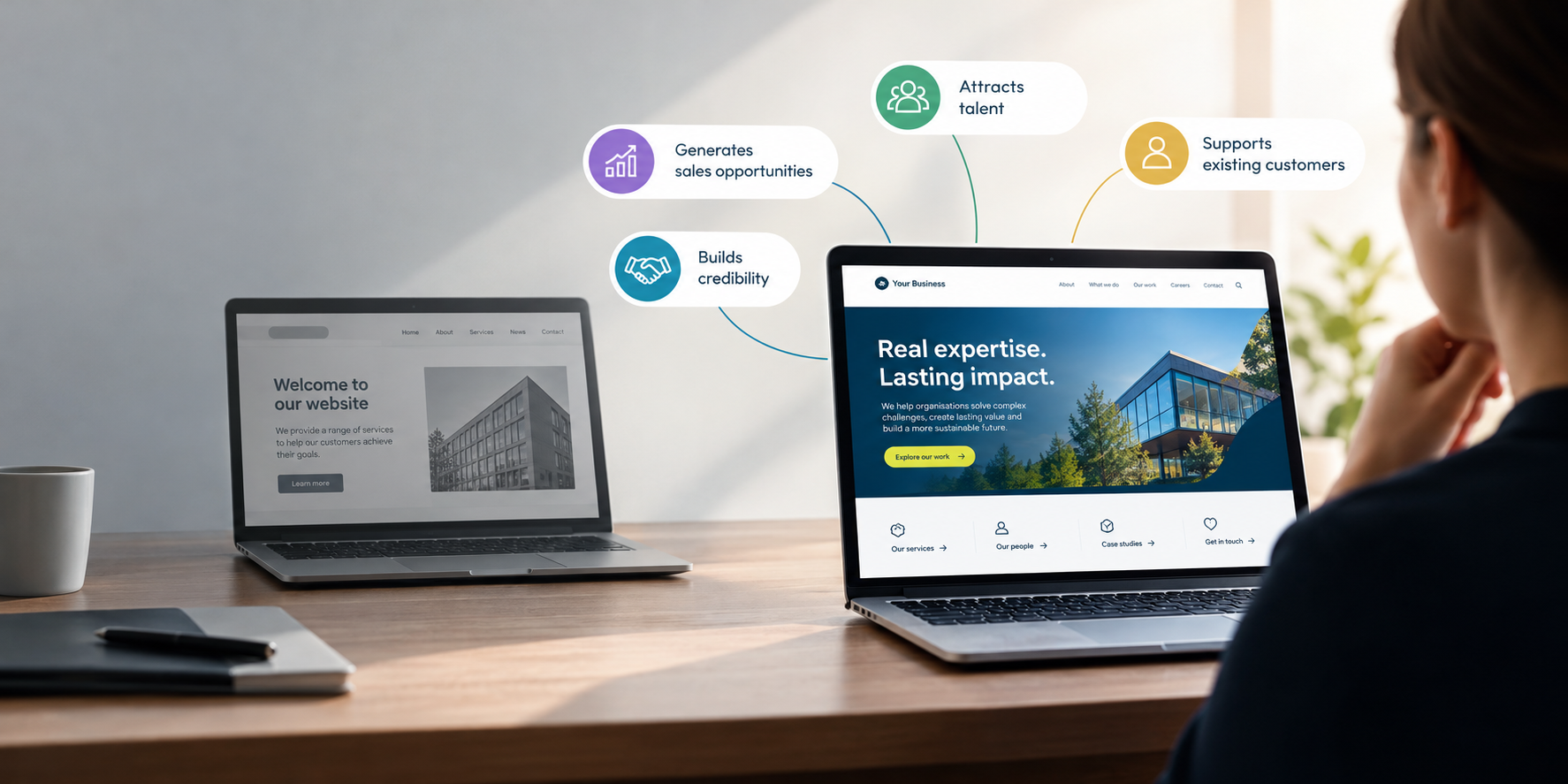
The most expensive website isn’t necessarily the one that cost the most to build. It could be the perfectly adequate one you’ve had for years.
It works. Nothing’s broken. It looks reasonably professional. It contains all the information you’d expect, and nobody’s complaining about it.
So why change it?
Because there’s a difference between a website that works and a website that’s working hard enough for your business.
An average website rarely announces that it’s underperforming. It doesn’t tell you about the prospective customer who looked elsewhere, the talented candidate who wasn’t impressed or the potential partner who struggled to understand what makes your organisation different.
Those opportunities simply disappear. And that’s what makes an average website potentially more expensive than you think.
The problem with ‘good enough’
Most organisations recognise when their website has a serious problem. Broken functionality, outdated information or a frustrating user experience will eventually demand attention.
But what about the website that does everything reasonably well?
It might have been built several years ago, when the business looked quite different. Since then, the organisation has grown, developed new services, entered new markets or changed its proposition.
The business has moved forward. The website hasn’t necessarily kept pace. And because nothing is obviously wrong, there’s little urgency to address it.
The question isn’t simply whether your website works. It’s whether it still represents the business you’ve become.
Where the real costs appear
The consequences of an underperforming website aren’t always obvious. They can affect different parts of an organisation, often without anyone recognising the connection.
Sales opportunities
A website doesn’t have to generate an enquiry to influence a sale. A prospective customer may already have heard about you through a recommendation, a meeting or a conversation with your sales team.
Their next step is often to look you up.
If they struggle to understand your capabilities, find relevant examples of your work or see what differentiates you from competitors, that initial confidence can quickly diminish.
Your sales team may find itself answering questions the website should already have addressed, or overcoming doubts that didn’t need to exist.
Recruitment
Talented people research prospective employers just as carefully as customers research suppliers. They want to understand the organisation, its culture, its ambitions and the people behind it.
If your website presents an outdated or uninspiring picture, it may be doing little to support your recruitment efforts, regardless of how attractive the opportunities actually are.
Business credibility
Whether you’re approaching new markets, seeking investment or developing commercial partnerships, your website plays a part in establishing confidence.
An organisation may have exceptional expertise, impressive clients and a strong track record. But if those strengths aren’t communicated effectively, visitors are left to make their own assumptions.
And those assumptions aren’t always favourable.
Existing customers
The relationship doesn’t end when someone becomes a customer.
People return to websites for information, support, additional services and reassurance that they’ve made the right choice.
A confusing or inconsistent experience can create unnecessary frustration, increase demands on your team and weaken an otherwise positive relationship.
None of these problems necessarily appears as a dramatic failure. But collectively, they can represent a significant commercial cost.
What your website analytics won’t tell you
Most businesses have some understanding of how their website is performing. They can measure visitor numbers, traffic sources, enquiries and conversions.
These are useful indicators, but they don’t tell the whole story.
Analytics won’t necessarily reveal the prospective customer who decided not to get in touch, the candidate who chose not to apply or the commercial opportunity that quietly went elsewhere.
That’s why website performance needs to be considered in a wider business context.
Is your website doing your business justice?
A good website doesn’t need to be complicated, expensive-looking or packed with the latest digital features.
It needs to communicate clearly, work effectively and accurately represent the organisation behind it.
It should make life easier for customers, support commercial conversations and help different audiences find what matters to them.
Most importantly, it should keep pace with the business.
That doesn’t necessarily mean a complete redesign every few years. Sometimes the biggest improvements come from reconsidering the content, navigation, user journeys or how the organisation presents its capabilities.
Matt Sayers, Digital Lead at Switch, says:
“One of the first things we encourage every business to do is look at its website through the eyes of a first-time visitor. Can someone quickly understand what you do, what sets you apart from the competition, and what they should do next? You might be surprised how often a website makes perfect sense to the people who work behind the scenes, but leaves potential customers with more questions than answers.
Here’s a simple test to find out how well your website is performing. Ask a friend to sit down at a laptop, open your homepage and spend 30 seconds looking around. Then ask them three questions: What does the business do? What makes it different? And how would you get in touch? If they struggle to answer, it could be a sign that your website needs some attention.
But don’t assume that an underperforming website needs a complete rebuild. We understand that every business has different needs and budgets, and meaningful improvements don’t always require a major investment. Sometimes, simply refining your wording, making your key messages clearer and reordering your content can make all the difference.”
Final lightbulb moment
If your website has been in place for several years, it’s worth looking at it with fresh eyes.
Not simply to ask whether it looks dated or whether the technology still works.
But to consider whether it genuinely reflects the quality, capabilities and ambitions of your organisation today.
Does it make your proposition clear? Does it give prospective customers confidence? Does it support your people and your commercial objectives?
And perhaps most importantly, if you were encountering your organisation for the first time, would your website give you a compelling reason to take the next step?
Because an average website doesn’t necessarily lose business by doing something wrong. Sometimes it loses opportunities simply by not doing enough.
At Switch, we combine brand thinking, content strategy, design and digital development to create websites that do more than look good.
If you’re questioning whether your current website is doing your business justice, we’d be happy to take a look.
Let’s talk.